
News Single
Focus On Connecting And Cooling
Heat Pipe Heat Sink
Heat Pipe Heat Sink
A heat pipe heat sink is assembled from copper heat pipes, an aluminum base plate, and aluminum cooling fins. Working on the vacuum phase-change principle inside the heat pipes, it rapidly transports heat away from concentrated hot spots on the chip to the dense fin stack above, where forced convection from a fan quickly dissipates it into the air.
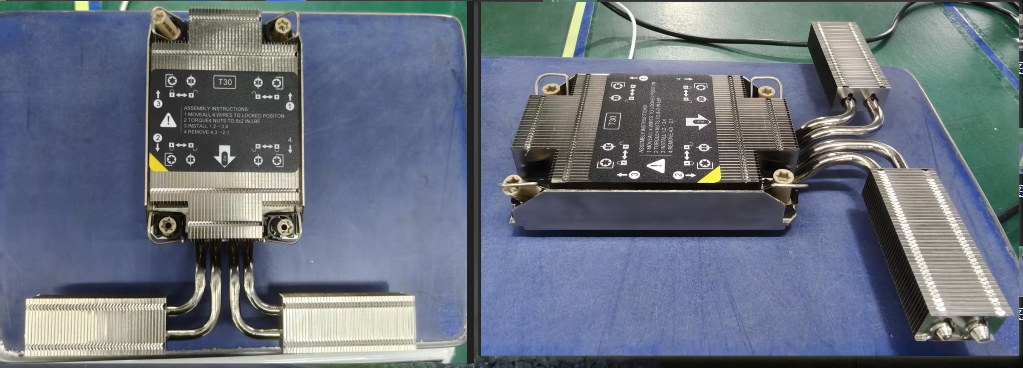
We specialize in custom heat sinks across the full range of bent heat pipe + aluminum base plate + threaded-fin configurations, with three-dimensional heat pipe bending layouts designed around the customer's PCB structure, chassis height, and heat source location. Sintered heat pipes are supported in all sizes - Φ4 / Φ5 / Φ6 / Φ8 / Φ10 - and fin thickness, fin pitch, and base plate thickness can all be customized on request.
I. Core Performance Advantages
1. Phase-change heat transfer in the heat pipes gives long-distance heat transport far beyond that of solid extruded aluminum, making it well suited to high-power concentrated heat sources;
2. Heat pipes can be bent into custom layouts, flexibly avoiding interference with internal chassis structures;
3. Compared with VC (vapor chamber) heat sinks, material costs are lower and the supply chain is mature;
4. The large heat exchange area, combined with forced air cooling from a fan, meets the high-power cooling demands of servers and industrial control boards.
II. Complete Technical Specifications and Standard Parameters
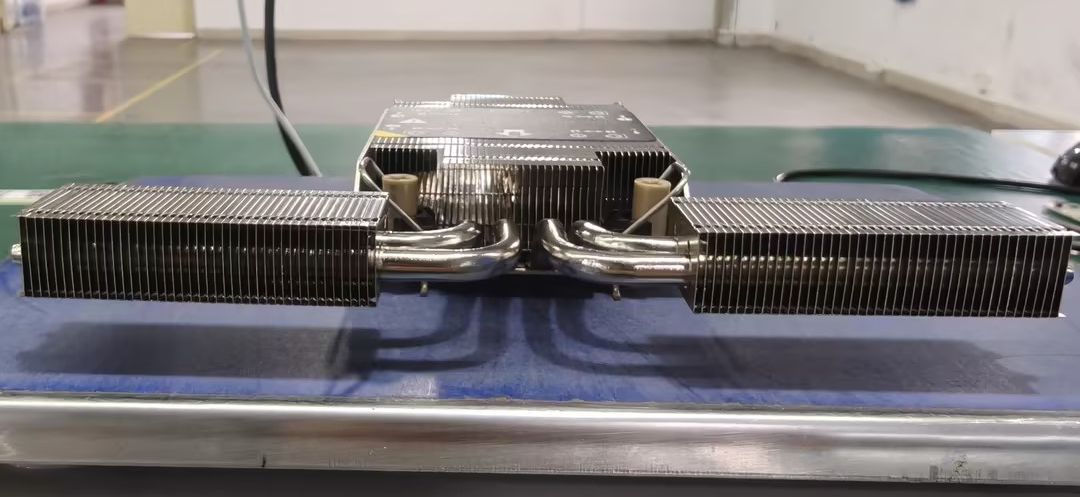
1. Aluminum Base Plate
Material: 6063 / 6061 aluminum alloy
Common thickness: 3 mm, 5 mm
Process: CNC face milling, tapping, profile milling; flatness controlled to ≤ 0.05 mm
Surface: black anodizing
2. Copper Heat Pipes
Shell: TP2 copper, sintered capillary wick heat pipe
Specifications: Φ5 mm, Φ6 mm, Φ8 mm, Φ10 mm pure-water heat pipes
Process: cut to length, CNC bending; minimum bend radius ≥ 3× the pipe diameter, flattening at bends held below 10%
Surface treatment: nickel plating preferred, to prevent oxidation and lower interface contact thermal resistance
3. Aluminum Threaded Fins
Material: A1050, A3003 aluminum strip
Fin thickness: 0.1-0.15 mm
Fin pitch: 2.0-3.5 mm
Fin height: approx. 15-32 mm on the units shown
III. Full Production Process
1. Aluminum Base Plate Machining
CNC profile milling of the aluminum sheet, milling of the locating face, and tapping of the mounting threads; surface grinding and deburring to guarantee the flatness of the plate's contact face.
2. Heat Pipe Pre-forming
Pipe cutting → CNC bend forming → degreasing and cleaning; bend position and bend radius are strictly controlled to avoid flattening and blockage of the pipe.
3. Fin Assembly Fabrication
Aluminum strip is progressively stamped into individual fins (with pre-punched heat pipe holes) → fins are stacked in alignment → heat pipes are inserted through the fin holes
→ Tube expansion: an expansion ball widens the heat pipe wall, eliminating the air gap between the pipe and the fin hole.
4. Assembly of Heat Pipes to the Aluminum Base Plate
The underside of the heat pipe evaporator section is mated to the surface of the aluminum base plate; choose one of two interface options:
① Low-temperature brazing: lowest contact thermal resistance, excellent vibration resistance;
② Press-fit with high-conductivity thermal grease / a thermal solder preform: lower cost and easier rework;
5. Accessory Assembly
The sheet metal bracket is fastened, with spring screws and locating posts pre-installed;
6. Surface Treatment and Final Inspection
Anodizing of aluminum parts; nickel plating of copper heat pipes; sampling thermal resistance tests and vibration reliability spot checks.
IV. Key Process Control Risk Points
1. Heat Pipe Bending Control
An excessively small bend radius, or flattening of the pipe wall beyond specification, compresses the internal vapor channel and directly causes a sharp drop in the heat pipe's heat transfer capability.
2. Thermal Resistance at the Heat Pipe / Aluminum Base Plate Interface
Brazing copper heat pipes directly to an aluminum base plate readily forms brittle copper-aluminum intermetallic compounds, which lead to cracking of the joint.
Recommended approach: press-fit with a thermal interface material, or low-temperature soldering using a transition shim.
3. Base Plate Flatness and Mounting Pressure
Uneven fastening loads on the base plate cause warping, opening gaps between the plate and the chip. The role of spring screws: to distribute pressure evenly and compensate for slight deformation of the flat surface.
V. Applicable Industries and End Applications
1. Computing Server Sector
1U / 2U rack servers, AI edge computing cards, GPU accelerator cards, industrial server CPU heat sinks;
2. Industrial Automation Electronics
High-power industrial control motherboards, inverter main control modules, laser driver power supplies;
3. Automotive Electronics
In-vehicle computing platforms, autonomous driving domain controllers, energy storage converter modules;
4. High-End Communications Equipment
5G high-power base station units, high-density telecom power modules.
VI. Product Compliance Certifications
1. Management System Certification
1) ISO 9001:2015 quality management system certification;
2) ISO 14001 environmental management system.
2. Environmental Material Certification
1) RoHS 2.0 hazardous substance testing (lead, cadmium, mercury, hexavalent chromium, and phthalates all within limits);
2) Material certificates and SGS test reports provided for the raw aluminum.
3. Third-Party Performance Testing
1) Sampling thermal resistance tests;
2) Vibration reliability spot checks.
VII. Prototyping & Mass Production Delivery
1. Custom-shaped copper pipe profiles and irregular fin layouts are supported; prototyping lead time 18-28 days;
2. Fin height and fin density can be matched to the customer's overall unit height, airflow, and power consumption;
3. Both sample trial builds and volume production are supported, with complete modules deliverable including spring screws and thermal pads;
4. Extended options: the cooling module can combine heat pipes with a compact water-cooling block to create a hybrid cooling solution.
Q1: The heat pipes sit flush against the aluminum base plate - why not machine grooves and embed them directly?
A: Embedding requires milling grooves into the base plate, which means the plate has to be thicker. In this design the heat pipes are attached to the plate surface, which keeps base plate thickness - and therefore overall height - down, suiting the limited space inside a chassis. The trade-off is that contact thermal resistance at the interface is slightly higher than with an embedded-pipe structure.
Q2: If this heat sink is mounted horizontally or inverted, will heat pipe performance degrade?
A: The product uses sintered heat pipes, which support mounting at any angle. With grooved heat pipes, heat transfer capability drops noticeably when inverted, so always confirm the heat pipe's capillary wick structure when selecting a model.
Q3: Between the heat pipe and the aluminum base plate, is thermal grease or soldering better?
A: For vibration-prone conditions and sustained high-load operation, soldering is preferred because its thermal resistance is stable; for prototypes and products that may need rework later, use the high-conductivity thermal grease option.
Q4: Can cooling capacity be increased by adding more heat pipes?
A: In principle yes, but the available layout space on the base plate and the airflow through the duct have to be evaluated. Any added heat pipes must be matched by sufficient fin surface area, otherwise adding pipes will not effectively lower temperatures; CFD flow field simulation is recommended to verify the design.
Q5: How does this compare with an extruded aluminum heat sink, and how should I choose?
A: For low power with an evenly distributed heat source, choose extruded aluminum; for high power, pronounced localized hot spots on the chip, and heat that must be moved a longer distance, choose this heat pipe heat sink. For a given volume, a heat pipe design has a higher cooling ceiling.
Q6: Will heat pipes fail over long-term use? How long do they last?
A: A properly sealed sintered heat pipe lasts 5-10 years in a normal industrial environment. Failures are mainly corrosion and seepage at the seal, or the build-up of non-condensable gas inside. In high-humidity and salt-spray environments, nickel plating is recommended for corrosion protection.


 Send Email
LiveChatclose