
News Single
Focus On Connecting And Cooling
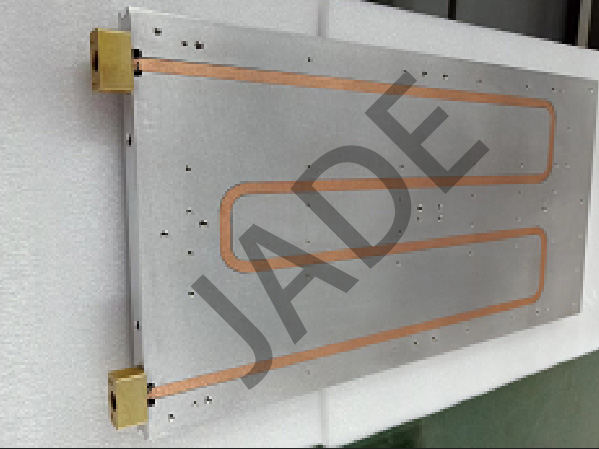
Buried Copper Tube Liquid Cold Plate
Buried Copper Tube Liquid Cold Plate
In a buried copper tube liquid cold plate, grooves matching the designed flow path are first CNC-milled into an aluminum alloy base plate; precision-bent copper tubes are then embedded into the grooves and fixed by mechanical press-fit or brazing, forming a sealed internal coolant channel. Coolant circulates through the copper tubes and rapidly carries heat away from the heat-generating components, delivering efficient and uniform cooling.
We offer a full range of non-standard custom buried copper tube cold plates. Base materials include 6061 aluminum alloy and copper plate, and oxygen-free copper tubing is used for the coolant channel. Three process routes are available: shallow embedding with press-flatten milling, deep embedding sealed with thermal adhesive, and buried tube plus vacuum brazing. Working from customer drawings we complete CNC grooving, copper tube bending, tube press-fit, precision surface grinding, and nickel plating / passivation for corrosion protection, together with fitting assembly and airtightness / hydrostatic leak testing. Designs can be optimized to customer requirements, supporting the full path from sample development to volume delivery. The product is widely used in liquid-cooling projects for energy storage, industrial power supplies, laser equipment, high-power converters, and similar applications.
I. Core Performance Advantages
1. Excellent Cooling Performance
Pure copper has a thermal conductivity of 401 W/(m·K), far above that of aluminum; combined with the press-fit tube contact plus thermal filler process, interface thermal resistance is extremely low. At full load, the temperature difference across the plate surface is ≤ 3-5 °C, giving excellent thermal uniformity.
2. Weld-Free, Leak-Proof
Zero weld-related leakage risk: the flow channel is formed by a single seamless copper tube with no weld joints, eliminating the leakage hazard associated with traditional welded cold plates.
3. Corrosion-Resistant, Scale-Resistant, Longer Service Life
Pure copper tubing is compatible with deionized water and is acid-, alkali-, and corrosion-resistant, with low scaling tendency. Service life can exceed 10 years, suiting equipment that must run without interruption.
4. Lightweight, Highly Adaptable Structure
The main body uses an aluminum alloy base, cutting weight by more than 40% versus an all-copper cold plate. Overall equipment load is reduced, making it well suited to compact equipment designs.
II. Complete Technical Specifications and Standard Parameters
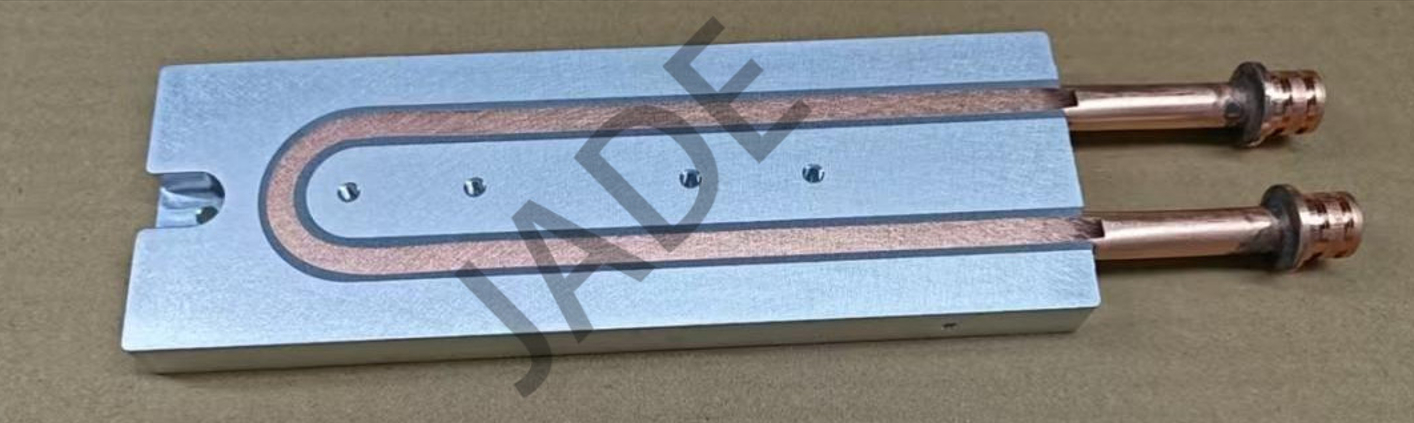
1. Core Material Specifications
Base plate material: AL 6061 / 6063 / 1060;
Flow channel material: C1220 oxygen-free copper, C1100 pure copper;
Common tube diameters: Φ6, Φ8, Φ10, Φ12, Φ14 mm - non-standard sizes on request;
Plate thickness range: 10 mm-50 mm, customized on request.
2. Process Types
Shallow embedding with press-flatten milling; deep embedding filled with thermal adhesive; buried tube plus cover-plate brazing.
3. Performance Parameters
Operating temperature: -40 °C to 120 °C;
Flatness: ≤ 0.05 mm / 100 mm, ensuring intimate contact with the device;
Airtightness test: 0.8 MPa held for 30 minutes with no leakage;
Hydrostatic test: pressure test at 1.5× rated pressure;
Surface temperature uniformity: ΔT < 2 °C
III. Full Production Process
1. CNC grooving of the base plate: grooves for the embedded copper tube are milled to drawing;
2. Oxygen-free copper tubes are bent to form, setting the flow path routing;
3. The copper tube is pressed into the aluminum groove and bonded using press-flatten milling or thermal-adhesive filling;
4. Precision surface grinding to correct and guarantee base plate flatness;
5. Surface passivation for corrosion protection, to prevent galvanic corrosion between copper and aluminum;
6. Fittings are assembled, followed by airtightness and hydrostatic leak testing;
7. Final dimensional and visual inspection, packing, and shipment.
IV. Applicable Industries and End Applications
1. New-Energy Storage
Commercial & industrial energy storage cabinets, residential energy storage systems, liquid cooling for power-battery PACKs, energy storage converters
2. Industrial Power Equipment
High-power variable-frequency drives, inverters, IGBT power modules, servo drives, UPS uninterruptible power supplies
3. Laser and Precision Equipment
Fiber lasers, laser power supplies, precision instruments, temperature-controlled cooling for medical equipment
4. New-Energy Automotive Equipment
On-board chargers, electronic control modules, cooling systems for new-energy construction machinery
5. Computing and Communications Equipment
GPU cooling, server cooling, IDC data center cooling
6. New-Energy Power Generation
Cooling for large photovoltaic inverters and wind-power converters
V. Product Compliance Certifications
1. Management System Certification
1) ISO 9001:2015 quality management system certification;
2) ISO 14001 environmental management system.
2. Environmental Material Certification
1) RoHS 2.0 hazardous substance testing (lead, cadmium, mercury, hexavalent chromium, and phthalates all within limits);
2) Material certificates and SGS test reports provided for the raw aluminum.
3. Third-Party Performance Testing
1) Sampling thermal resistance tests;
2) Vibration reliability spot checks.
VI. Prototyping & Mass Production Delivery
1. Custom irregular flow-channel layouts and multiple embedding processes are supported; prototyping lead time 7-12 days;
2. Tube diameter and plate thickness can be matched to the customer's overall unit space, heat loss, and flow-rate requirements;
3. Both sample trial builds and volume production are supported, with complete modules deliverable including fittings and sealing kits;
4. Extended options: the cold plate can be combined with heat pipes or a vapor chamber to build an integrated hybrid cooling solution.
Q1: Will a buried copper tube cold plate leak?
No. The core flow channel is a single seamless pure-copper tube with no welded joints, eliminating leakage risk at source. Every unit undergoes 100% airtightness plus hydrostatic testing before shipment, and under normal operating conditions there is no leakage over the product's service life.
Q2: How do I choose between a buried copper tube cold plate and a brazed cold plate?
For leak-proofing, low cost, long-term stability, and large-volume production, the buried copper tube cold plate is the first choice. For ultimate temperature uniformity, fine and complex flow paths, and ultra-high heat flux density, choose a vacuum-brazed cold plate.
Q3: Will galvanic corrosion occur between the copper and aluminum in an aluminum-based buried tube design?
A properly engineered process includes insulation, isolation, and surface passivation to block any conductive medium between the copper and aluminum, preventing galvanic corrosion and making the plate suitable for long-term liquid-cooling operation.
Q4: Can you build custom irregular shapes and non-standard sizes?
Yes - fully non-standard custom sizes are supported. We can mill clearance pockets, cut grooves, drill holes, and tap threads on request, to fit all kinds of custom enclosures and special mounting structures.
Q5: Is cooling performance much worse than an all-copper cold plate?
The core heat-conducting flow channel is pure copper, so cooling performance is close to that of an all-copper cold plate. Only the base plate is aluminum, which gives a large advantage in weight and cost-effectiveness over all-copper designs. It fully meets the needs of the vast majority of medium- and high-power liquid-cooling applications.
Q6. What is the service life?
Pure copper tubing is corrosion- and aging-resistant. Under normal industrial and energy-storage conditions, service life can exceed 10 years - far longer than that of typical brazed cold plates.


 Send Email
LiveChatclose